

In the aftermath of the assault on Gaza in October 2023, the killing of children has become a figure, a margin, a unit of calculation. According to the UN Office for the Coordination of Humanitarian Affairs (OCHA, May 2024), more than 14,000 children have lost their lives. Not propaganda, not speculation, but a number that remains like a scar. And even that number is increasingly dismissed as irrelevant. The dead child is acknowledged, but does not count.
The word “irrelevant” is anything but neutral. It marks a moral rupture, a moment when political logic detaches itself from human reality. What does it mean when a society accepts that the life of a child is subordinate to military gain? At what point is a human body stripped of all meaning?
The Measure of Relevance
There is a threshold that requires no front line to be crossed: the moment when a child loses statistical significance.
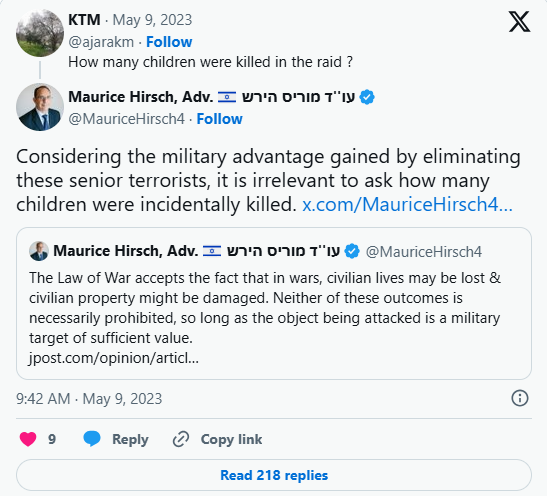
In May 2023, a user on X asked a simple question:
How many children were killed in the strike?
Israeli jurist Maurice Hirsch replied:
“Given the military advantage of eliminating those senior terrorists, it is irrelevant to ask how many children were incidentally killed.”
Shortly thereafter, Israeli ambassador to the UK, Tzipi Hotovely, echoed the sentiment in an interview with Piers Morgan:
“That number is irrelevant.”
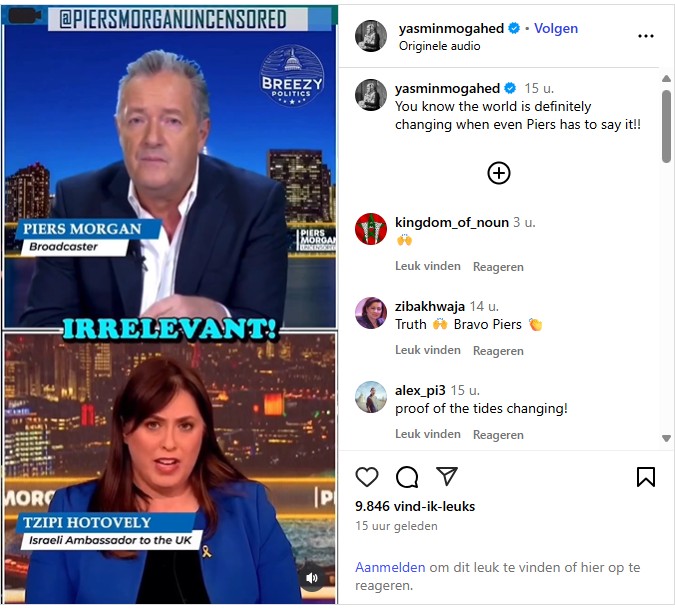
Watch full video on https://www.instagram.com/reel/DKVWy56uVEL/
It is not a denial. Not a dispute. But a formal erasure of meaning.
What takes place here is not a standard political or military reasoning. It is a linguistic operation in which the dead child is not denied, but reclassified. Not as a tragedy, but as a footnote. The human element is stripped of its moral force. What remains is an abstraction without a face.
Language here does not merely describe. It functions as an instrument of power. It decides who speaks, who remains silent, and above all, who counts. The use of the word “irrelevant” does not simply interrupt moral discourse. It codes such discourse as inappropriate before it can begin. The dead child is no longer questioned, but morally neutralized. The question itself, of meaning, responsibility, and human value, is silenced.
“Irrelevant” does not only mean that something has no weight. It means that it may not be granted any weight. It is a linguistic exclusion. What is said must no longer have consequence. The obvious horror of killing children is recast in a vocabulary of superiority, the language of those who remain untouched, who are not moved, who define what matters and what does not.
Only those with symbolic and political power can afford to speak this way. To say “irrelevant” is to speak from an elevated position: outside the impact, outside the grief, outside the blame. The word carries an authoritarian character. It presents itself as technical, but is in essence a hierarchical act, a quiet directive toward indifference.
Empathy is reduced to an error in the chain of command. Compassion becomes a glitch. The shift is cultural. What was once unthinkable is now processed as administrative detail. This language is not the symptom of barbarism. It is its strategy.
Life Without Value
The Italian philosopher Giorgio Agamben describes this condition with chilling clarity. In his book Homo Sacer: Sovereign Power and Bare Life (1995), he revives a paradoxical figure from Roman law: the homo sacer, a person who could be killed without the act being considered murder, yet who could not be sacrificed in a religious rite.
This figure lives in a legal gray zone. Biologically alive, but politically dead. No longer a citizen, no longer protected by law or community, yet still present. Agamben calls this “bare life”, a body that exists without meaning, exposed to violence without consequence.
In today’s world, it is the bodies on the edges of war, borders, and bureaucracy that embody this bare life: refugees in detention, civilians in occupied territories, children buried beneath rubble in so-called strategic bombardments.
When their deaths are deemed irrelevant, Agamben’s insight is realized. Life remains visible, but no longer counts. Not because it does not exist, but because it has ceased to matter.
The state, which should protect, withdraws. What remains is only the power to kill. In this state of exception, the right to life is no longer a safeguard, but a variable in a larger calculation.
Against Forgetting
What makes the word “irrelevant” so unbearable is that it does not deny the killing, it legitimizes it. It is not hysteria, not panic, not accusation. It is a clerical write-off. An administrative deletion of meaning. No justification, no mourning. Just a silent liquidation of what once mattered.
The conversation does not end in conviction, but in a spreadsheet. The catastrophe lies in the tone: polite, technical, absent.
This is why naming, remembering, and writing are not luxuries. They are acts of resistance. Against the forgetting in which human lives vanish the moment they lose their “value.”
There are words that kill. And there are sentences that seal the grave.
A politics that calls the killing of children irrelevant does not defend democracy. It betrays everything that once made civilization possible.
